Everyone selling a GEO tool now ships an "AI visibility score." A single number, usually out of 100, that tells you how often AI answers mention your brand. It's a useful number. It's also one of the easiest numbers to misread. Here's how I've learned to use these scores - and the three things that matter more than the score itself.
1. A score is meaningless until you define the prompts
An AI visibility score is never absolute. It's always a score for a set of prompts. "We're at 42" means nothing until you can answer: 42 on which questions, asked the way which buyer asks them?
So the first piece of work isn't measurement, it's specification. Every company should decide - deliberately - the prompt set it wants to be visible on. The questions your actual customers type before they buy. The comparisons they run. The category terms where being absent costs you a deal. Pick those, and your score becomes a real signal. Skip this, and you're optimising for whatever prompt list a tool happened to ship with, which is to say, for nobody in particular.
This matters even more because some tools hand you a default score before you've chosen anything. Semrush, for example, computes its headline AI Visibility Score across a database of 261M+ AI queries - a broad, brand-level "share of presence" reading, not a measure of the questions that actually matter to your business. The narrowing is on you: be sure to adjust the score to the prompts you want to be cited on, rather than accepting the default universe.
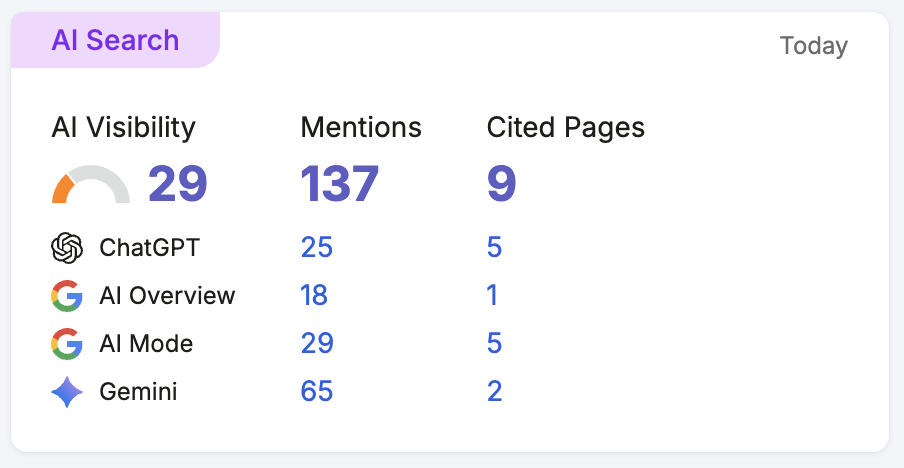
Define the prompt set first. The score follows the prompts, not the other way around.
2. Don't worship the number's movement
There are many ways to measure AI visibility, and no two tools do it the same way. Different models, different sampling, different scoring of a "mention" versus a "recommendation," different handling of a generation that varies every time you run it. On top of that, the good tools change their own methodology as they learn - which is the right thing to do, but it means your number can move without your reality moving at all.
So a score that ticks up three points month-on-month might be progress, or it might be a tweak in how the tool counts. Over-indexing on these movements is risky. Use the score for direction and rough magnitude, not for victory laps over a few points. If you're going to trust a trend, trust one measured the same way over a meaningful stretch - and even then, hold it loosely.
3. The thing the score is a proxy for: traffic
Visibility isn't the goal. It's a leading indicator for the goal. What actually matters is downstream and measurable in your own analytics:
- Are you getting traffic from AI tools at all? Referrals from ChatGPT, Gemini, Perplexity - is anyone arriving from there?
- Is that traffic growing? Month over month, is the AI-sourced share of your sessions trending up?
- Is it engaged? AI-referred visitors who bounce in four seconds are not a win. Look at what they do once they land.
Here's what that looks like in practice. With one client right now, AI tool traffic didn't crack the top five channels through the first quarter - it was there, but negligible, a rounding error, while we did the unglamorous foundational work, the kind that doesn't move a visibility score for weeks. Then it started compounding, month after month, until by May it had grown enough to break into the top five channels, edging past ones that had been there for years.
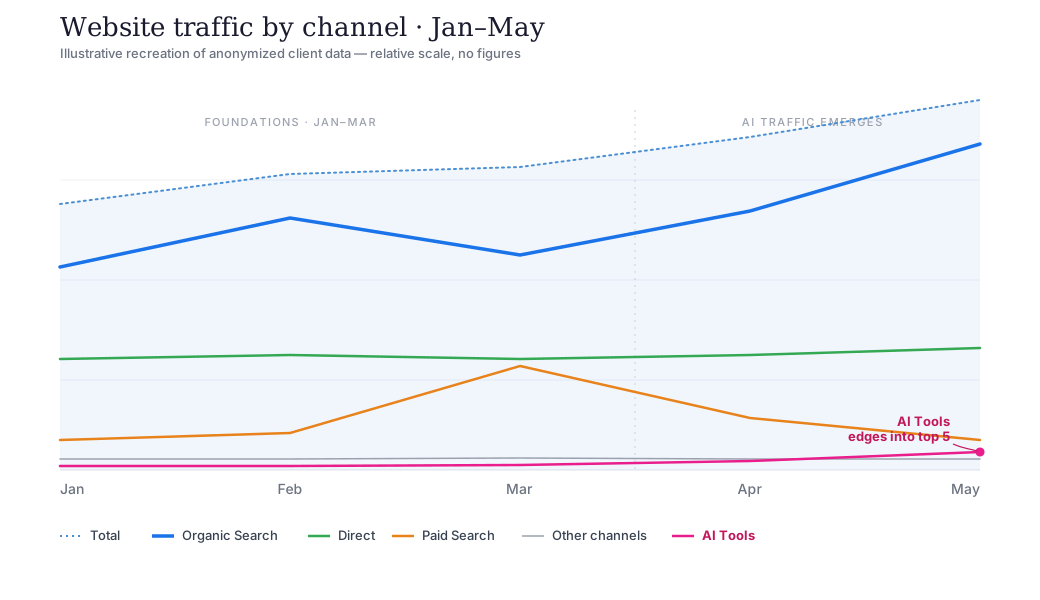
Note: "AI Tools" here means referrals from ChatGPT, Gemini, Perplexity and the like. Clicks from Google's AI Overviews usually land under organic search, not as a separate AI source - so they sit inside the Organic line, not this one.
It's still a thin sliver next to organic search, which remains the giant. But the shape is unmistakable: a new channel arriving, climbing, on a slope the others aren't on. That's the signal worth acting on - not its absolute size today, but its trajectory, and the fact that it showed up after the foundational work, not before.
A high score that produces no growing, engaged traffic is a vanity number. Lower-scoring competitors who are quietly compounding real AI-driven traffic are winning. Always reconcile the score against what's actually showing up in your funnel.
And a caution in the other direction: don't let the AI conversation talk you out of Google. In India especially, classic Google search still drives the majority of my traffic by a wide margin. The direction of travel is not in doubt - at Google I/O 2026 the company called its AI-reimagined search box the biggest change in over 25 years and made Gemini the default in AI Mode, which means "search traffic" and "AI traffic" are converging into the same thing. That shift will arrive quickly. It just hasn't arrived yet, not in the numbers that pay your bills today. So build for both: AI visibility is the growth edge worth investing in early, but it's additive, not a replacement. Treat it as a second engine you're building while the first one is still doing most of the work - not as a reason to take your hands off search.
The only question your report needs to answer
Here's where most teams get stuck, and I got stuck here too. You open the tool and it gives you everything. Hundreds of prompts, dozens of gaps, citation tables, sentiment breakdowns, competitor matrices. Every click leads to another set of to-dos. It's all true and it's all interesting and it is completely paralysing.
The honest reaction to that wall of insight is a plea: just tell me the top 10 things to do right now. Or give me a 30-day plan first. Finite. Prioritised. Doable this week.
So I think any AI visibility report should be built to answer exactly one question:
Directionally, what do I do to make a step change in my visibility relative to my competitor?
Not "what are all the things I could do." Not "here is everything we measured." Just the handful of moves, in order, that close the gap fastest.
I lived the other version of this. When I set out to solve AI visibility as a problem back in December 2025, every report I saw on the available tools buried the answer under more questions. The fix wasn't more data - it was a discipline of subtraction. That's the genesis of the Citable Monday workflow: finite, prioritised, served. Zero cognitive overload. You open it on Monday, you see the few things that matter most, you do them.
A score is a thermometer. It tells you something is hot or cold. It doesn't tell you what to cook. Use the number for direction, anchor yourself in real AI-driven traffic, and demand that your reporting hand you the next moves - not the next list of things to worry about.