Learning how to track brand mentions in AI search means checking, on a schedule, whether answer engines like ChatGPT, Perplexity, Gemini, and Google AI Overviews name your brand when buyers ask questions. This matters because AI answers now shape purchase decisions before anyone reaches your site. Note the scope: this measures whether you are named in the answer, not how much referral traffic AI sends you.
Buyers ask AI tools for recommendations now. They type "best cordless vacuum under 20000" into ChatGPT or Perplexity and read the answer. If your brand is not in that answer, you lose the sale before the buyer ever sees a search result. So you need to know: does AI name you, or your competitor?
Most founders have no idea. They check Google rankings weekly but never check what AI says. That gap is the opportunity. The good news: you do not need a fancy platform to start. You can run a clean manual check this week with a spreadsheet and an hour of focus.
This guide gives you a repeatable 4-step method. It is honest about the time cost and about when a paid tool starts to pay for itself. First, one important distinction that most guides skip.
Why track brand mentions in AI search
AI answer engines are becoming a first stop for product research. When a buyer asks "which brand should I buy," the model returns a short list of names. Your goal is to be on that list. Tracking tells you where you stand today and whether your work is moving the needle.
When Google shows an AI Overview, people click a traditional search result on 8 percent of visits, versus 15 percent when there is no summary, according to Pew Research Center (July 2025). That means the answer, not the blue link, is often what the buyer reads first. If you do not measure your presence in that answer, you are flying blind on a channel that already shapes demand.
Mention vs citation vs recommendation
Not every appearance in an AI answer is equal. Track three distinct outcomes, because they mean different things:
- Mention: the answer names your brand in the text, with no link. Good for awareness.
- Citation: the answer links to your site as a source. This can drive a click and signals the model trusts your content.
- Recommendation: the answer actively suggests your brand as a top pick, not just a passing name. This is the strongest signal and the hardest to earn.
Log these separately. A brand mentioned ten times but recommended zero times has a very different problem than one that is recommended but never cited.
The 4-step manual method
Run this method with a plain spreadsheet. It takes about an hour to set up and thirty minutes a week to maintain.
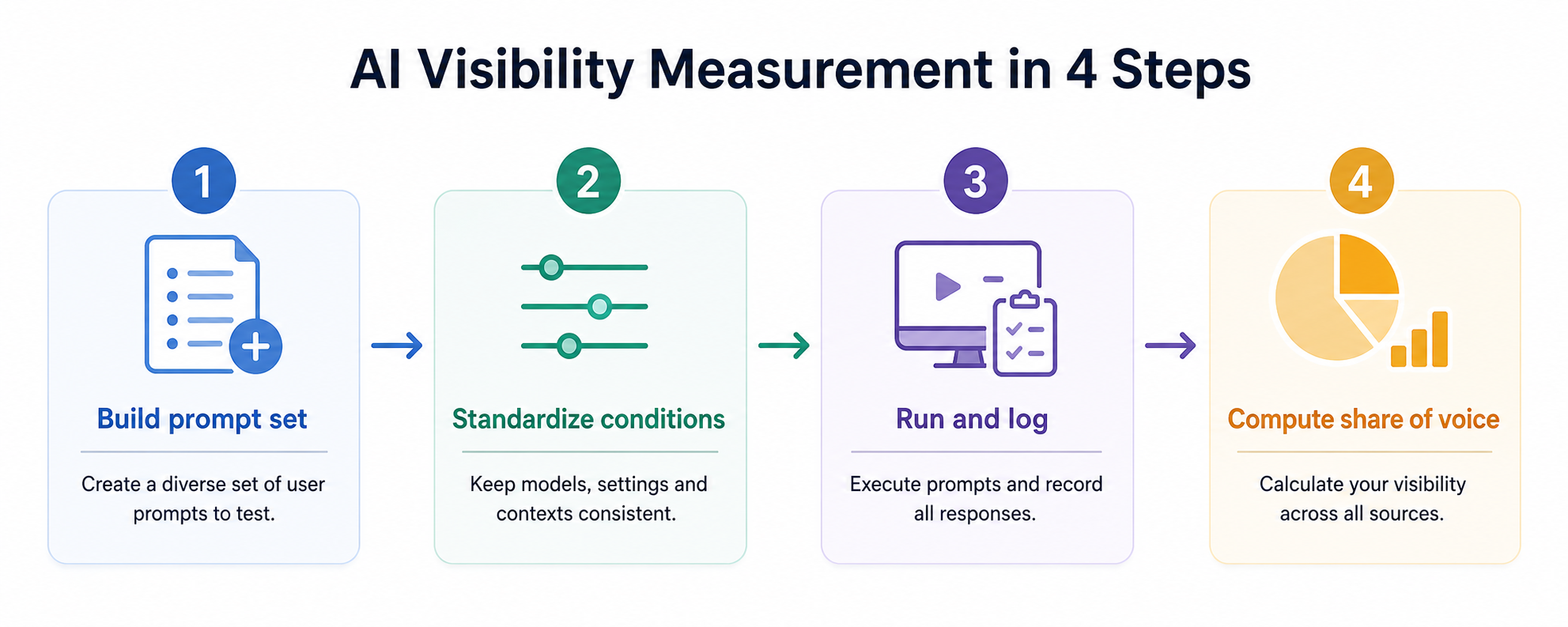
Step 1: Build a prompt set. List 15 to 25 real buyer questions. Pull them from your seed keywords, your sales calls, and your support inbox. Mix broad prompts ("best air conditioner for small rooms") with branded ones ("is [your brand] any good"). Keep this list fixed so results stay comparable week to week.
Step 2: Standardize conditions. Control the variables so your data means something. Use a logged-out or dedicated browser profile to reduce personalization. Fix your region, device, and the model version where you can. Test the same engines each time: ChatGPT, Perplexity, Gemini, and Google AI Overviews.
Step 3: Run and log. Paste each prompt into each engine. Record what you see for every run. Critically, run each prompt two or three times, because AI answers vary run to run. One run is an anecdote, not a measurement. Never trust a single result. Log to a sheet like this:
| Field | What to capture |
|---|---|
| Prompt | The exact question you typed |
| Engine | ChatGPT, Perplexity, Gemini, or AI Overviews |
| Date and run | Date plus run number (1, 2, 3) |
| Your brand | Mention, citation, recommendation, or none |
| Competitors named | Every rival brand in the answer |
| Position | Where you appear (first, middle, last) |
| Notes | Sentiment, quoted phrasing, source linked |
Step 4: Compute share of voice. For each prompt, count how many times your brand appears versus all brands named. Your share of voice is your appearances divided by total brand appearances across the set. Track it weekly. A rising number means your work is landing. A flat one tells you to change the content, not the tracker.
Benchmark your share of voice against competitors
Tracking your own mentions tells you whether you show up. Benchmarking tells you whether you show up more or less than your rivals. It uses the same sheet, with one extra step on top of the four-step method above.
Start from the prompt set you already built. Add three to five real competitors as new columns. For each prompt and each engine, mark every brand as cited (named with a link), mentioned (named without a link), or absent. You now have a grid of who appears where.
From that grid, compute your AI share of voice per engine, not just overall, because engines differ. Perplexity typically surfaces more sources per answer than ChatGPT, so your share can look very different from one platform to the next. Because AI answers vary between runs, run each prompt two or three times and average the results.
The value is in the gaps. Wherever a competitor is cited and you are not, open the exact page the engine cited and note why it won: a clearer direct answer, a stronger third-party source, fresher information. That page becomes your content brief. Re-run the benchmark monthly for fast-moving categories, quarterly for slower ones, and watch the share move.
When to use a tool vs stay manual
Manual tracking works well up to a point, then the time cost bites. Stay manual while you run 20 to 30 prompts on a weekly cadence. That is cheap and teaches you what "good" looks like in your category.
Switch to a paid AI search monitoring tool when your prompt set grows past 50, when you need daily checks, or when you want automated alerts on a competitor overtaking you. Tools like Otterly and Profound automate the runs and the math. Some teams instead script the Perplexity API for a fraction of a cent per query. For a current comparison, see our guide to the best AI visibility tools. The honest rule: buy the tool when the hour a week starts costing more than the subscription.
How this differs from GA4 traffic tracking
Tracking mentions answers a different question than tracking traffic. Mention tracking asks: does the AI name my brand in its answer, whether or not the buyer clicks? Traffic tracking asks: how many people clicked through from an AI tool to my site? Both matter, but they are not the same metric.
In Google Analytics 4 (GA4) you measure the clicks that AI referrals send you. That is downstream of the answer. A buyer can read your brand name, feel reassured, and buy later without ever clicking. Mention tracking captures that influence; GA4 cannot. For the traffic side, read our companion post on how to measure AI referral traffic in GA4. Run both to see the full picture.
Conclusion
You now have a method you can run this week: build a fixed prompt set, standardize your conditions, log mentions honestly across repeated runs, and compute share of voice. Start manual, sample repeatedly, and let the data tell you where AI already trusts you and where it does not. When the manual work outgrows your calendar, a tool earns its place. If you would rather have this run for you as a scored, tracked baseline, our AI Visibility Scores service benchmarks your brand across the major answer engines and tracks movement over time. Either way, the first step is the same: start measuring what AI says about you.
Frequently asked questions
How often should I track brand mentions in AI search?
Weekly tracking suits most lean D2C teams. A weekly cadence is frequent enough to catch shifts in how AI answers name your brand, but light enough to maintain by hand. Run each prompt two or three times per check, since AI answers vary run to run. Move to daily checks only when a launch or competitor push makes the extra effort worthwhile.
Can I track brand mentions in ChatGPT and Perplexity for free?
Free manual tracking works for both ChatGPT and Perplexity. Open each tool, paste your fixed prompt set, and log whether your brand is mentioned, cited, or recommended in a spreadsheet. This costs only your time. Paid tools add automation and alerts, but a spreadsheet is enough to start and to learn what your category looks like.
Why do AI search answers change every time I run the same prompt?
AI answers vary run to run because the underlying models generate text probabilistically and pull from live, shifting sources. The same prompt can return different brands on different runs. Sample each prompt two or three times and record every run. Treat one answer as an anecdote, and treat the pattern across several runs as your real signal.
Is tracking AI mentions the same as tracking AI referral traffic?
Mention tracking and referral traffic tracking answer different questions. Mention tracking checks whether an AI answer names your brand, click or no click. Referral traffic, measured in Google Analytics 4, counts the visits AI tools actually send you. A buyer can read your name and buy later without clicking, so run both metrics together for the full picture.
What is AI share of voice?
AI share of voice is the percentage of tracked brand mentions in AI answers that belong to your brand, measured across a fixed set of prompts and a fixed set of competitors. It is calculated per engine, because platforms cite different numbers of sources, and it shows your competitive position rather than your raw visibility.
Why is my competitor cited more than me in AI answers?
A competitor is usually cited more because the page an engine pulled answers the question more directly, or is backed by stronger third-party sources, or is more recent. Open the cited page, compare it to yours, and the reason is usually visible in the first screen of content.
Pew Research Center, "Google users are less likely to click on links when an AI summary appears in the results" (July 22, 2025): the finding that users click a traditional result on 8 percent of visits with an AI summary present, versus 15 percent without.
Tool names, pricing, and platform behaviour are current as of August 2026. AI answer engines change often, so verify against each platform directly before relying on a specific figure.