Answer Engine Optimization (AEO) is the practice of shaping content so answer engines quote it directly in a short reply. It matters because more shoppers now read one answer instead of scanning ten blue links. AEO is not a replacement for search work; it sits alongside older methods and depends on the same clean, factual pages.
Three acronyms keep showing up in D2C marketing chats: SEO, AEO, and GEO. Most articles blur them together. They use AEO and GEO as if they mean the same thing. They rarely tell you which one your brand should act on first.
This guide fixes that. I will give you one clean definition of each. Then I will show you how they differ in a single table. After that, I will make the case that you do not pick one. You stack them.
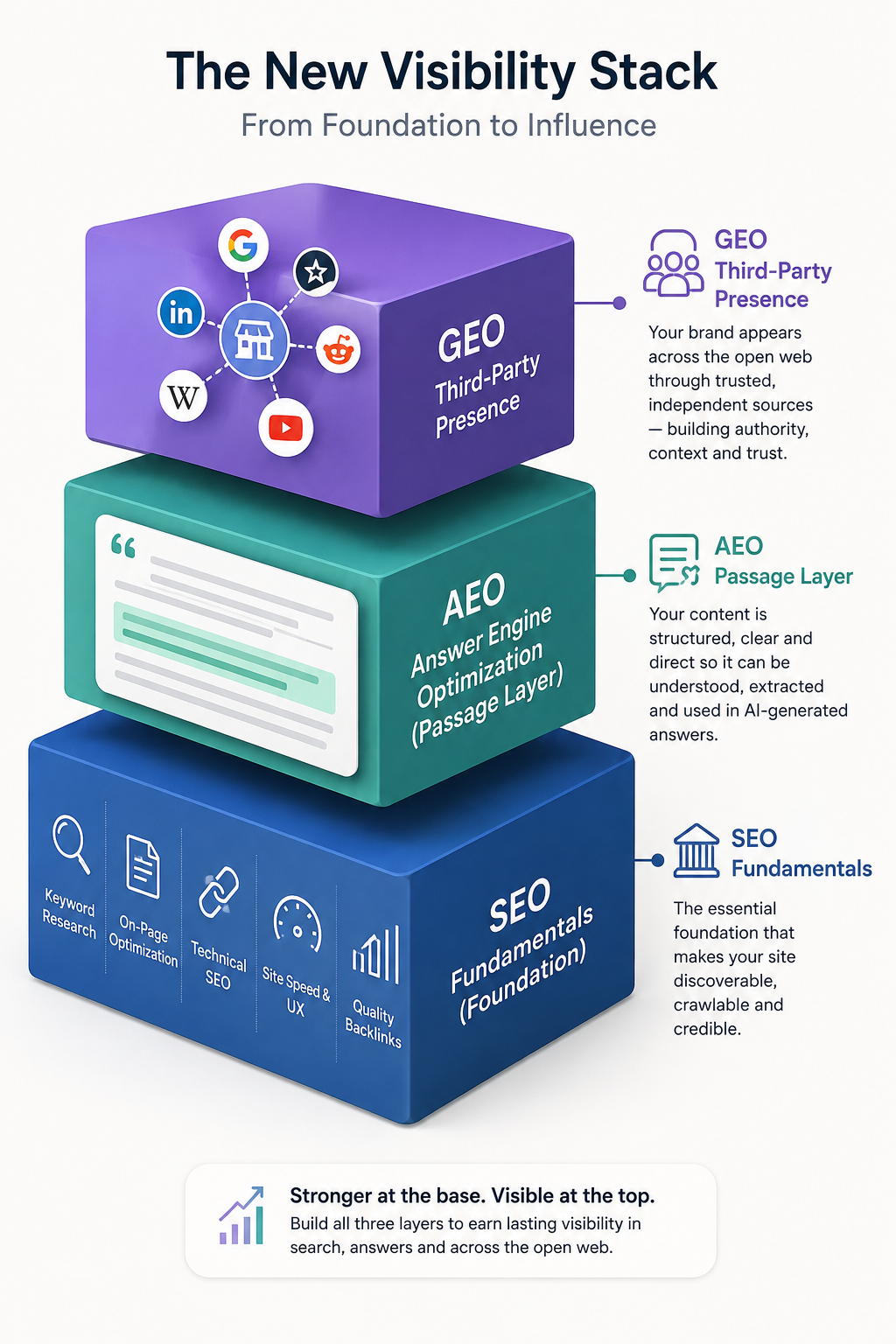
I look at this through a simple lens we use at Citable: owned, rented, and borrowed real estate. Owned is your own website. Rented is your ranking on a search results page. Borrowed is a mention or quote inside an AI answer or a third-party site. Each acronym maps to one of these. Once you see the map, the confusion goes away, and you can plan work that serves all three at once.
What is AEO (answer engine optimization)?
Answer engine optimization is the work of getting your content picked as the direct answer to a question. An answer engine is any tool that returns one reply instead of a list of links. Featured snippets, voice assistants, and AI chat replies all count. The goal is not a click. The goal is to be the sentence the engine reads back.
AEO rewards a few clear habits:
- Answer the exact question in the first two sentences.
- Use plain headings that match how people ask.
- Add structured data so machines parse your facts.
- Keep claims short, checkable, and self-contained.
Answer engine optimization meaning in one line: write so a machine can lift your passage without edits.
What is GEO (generative engine optimization)?
Generative engine optimization is the work of getting your brand cited inside AI-generated answers. Think ChatGPT, Google AI Overviews, and Perplexity. These tools write a fresh paragraph from many sources. GEO tries to make your brand one of those sources, named and linked where possible.
GEO leans on signals beyond your own site. AI models pull from reviews, forums, and reputable third-party pages. So being quoted often means being talked about in the right places. We wrote more on this in AI visibility is mostly plumbing, because much of GEO is unglamorous groundwork, not clever copy.
GEO and AEO overlap a lot. Both aim at machine-read answers. The split is scope. AEO targets a single lifted answer. GEO targets a spot inside a synthesized, multi-source reply. That is the honest version of GEO vs AEO.
What is SEO, and how do they differ?
Search engine optimization is the work of ranking your pages higher in classic search results. It is the oldest of the three. It optimizes for position on a list of links, driven by relevance, links, and page health. SEO wants the click. AEO and GEO often want the citation instead.
Here is the clean split on AEO vs SEO and AEO vs GEO:
- SEO earns a ranked link. The user still chooses and clicks.
- AEO earns the one answer read back to the user.
- GEO earns a named mention inside an AI-written paragraph.
They share a spine. All three need crawlable, accurate, well-structured pages. Weak SEO fundamentals quietly cap your AEO and GEO results too.
SEO vs AEO vs GEO: the comparison table
The table below sets the three side by side across four practical questions. Read it as one system, not three rival choices.
| Dimension | SEO | AEO | GEO |
|---|---|---|---|
| Goal | Rank higher and earn the click | Become the direct answer | Get cited in AI answers |
| Where it shows up | Search results list | Snippets, voice, quick answers | ChatGPT, AI Overviews, Perplexity |
| What it optimizes | Pages, links, page health | Passages, headings, structured data | Brand mentions across many sources |
| How you win | Relevance and authority | Clear, liftable answers | Trusted, consistent third-party presence |
Which one should a D2C brand care about?
D2C brands should care about all three, because they stack rather than compete. The real estate lens makes this concrete. SEO wins rented space on the results page. AEO wins the answer slot that sits above or instead of those links. GEO wins borrowed space inside AI replies and on third-party sites.
You cannot skip SEO and jump to GEO. AI answers pull from pages that already read as clear and trustworthy. Good structure for a snippet is also good structure for an AI model. One well-built page can serve a ranking, a snippet, and a citation at the same time.
So the practical order is simple. Fix your fundamentals first: crawlable, factual, well-structured pages. Then add answer-shaped passages for AEO. Then build the third-party presence that GEO needs. If you want tooling for the AI side, our roundup of the best AI visibility tools for 2026 is a good starting point.
The core AEO techniques, in plain terms
Definitions are useful, but the practical question is what you actually change on your site. Answer engine optimization comes down to a handful of techniques, and most brands can start with these five.
Answer the question directly. Put a clear, self-contained answer near the top of each key page, in two or three sentences an engine can quote without any surrounding context. Structure for extraction. Use question-shaped headings, short paragraphs, and valid schema so a machine can lift the right passage. Open access to AI crawlers. Allow the search crawlers that cite you, and publish an llms.txt that points to your best pages. Build third-party evidence. AI engines lean on independent sources, so earn mentions, reviews, and citations beyond your own domain. Measure and repeat. Track whether engines name and cite you, add competitors to see your share of voice, and fix the weakest pages first.
Each of these is a job in itself: allowing or blocking AI crawlers in robots.txt, creating an llms.txt, tracking brand mentions in AI search, and, when you want the whole picture scored, a full Brand Visibility Audit. Start with whichever layer is weakest for you.
Conclusion
AEO, GEO, and SEO are not three competing bets. They are three surfaces of one job: being found and being trusted when someone looks for what you sell. SEO earns the rented link. AEO earns the read-back answer. GEO earns the borrowed mention. The same clean, honest, well-structured pages feed all three.
The hard part is knowing where you stand today across each surface. That is what our Brand Visibility Audit is built to show you. It maps your owned, rented, and borrowed presence, then points to the fixes that move more than one surface at once. Start with the audit, then work the stack in order.
Frequently asked questions
What is answer engine optimization?
Answer engine optimization is the practice of writing content so answer engines quote it as the direct reply to a question. Answer engines include featured snippets, voice assistants, and AI chat tools. The aim is to be the passage the engine reads back, not just another link. Clear headings, plain answers, and structured data make this work.
Is AEO the same as GEO?
AEO and GEO are related but not the same. AEO targets a single lifted answer, such as a snippet or a voice reply. GEO targets a named citation inside an AI-written paragraph that blends many sources, like ChatGPT or AI Overviews. They share methods and often improve together, but their target surfaces differ.
Does SEO still matter with AEO and GEO?
SEO still matters and underpins both AEO and GEO. Search engine optimization builds the crawlable, accurate, well-structured pages that answer engines and AI models draw from. Weak SEO fundamentals limit how often you get quoted or cited. Treat SEO as the base layer, then add answer-shaped content and third-party presence on top.
Where does AEO fit in SEO?
AEO in SEO is best seen as a layer on top of classic search work, not a separate discipline. Search engine optimization earns the ranked link, while answer engine optimization shapes passages so engines lift them as direct answers. The same clean pages serve both, so most brands run them as one connected practice.
What are the main answer engine optimization techniques?
The main answer engine optimization techniques are: answering questions directly near the top of a page, structuring content for machine extraction with clear headings and schema, opening access to AI crawlers, building third-party evidence beyond your own site, and measuring which engines cite you so you can fix the weakest pages.
Do AEO and GEO need different content?
AEO and GEO share almost all the same content foundations: direct answers, clear structure, and credible sources. The difference is emphasis. AEO focuses on being the quoted answer, while GEO focuses on being cited across generative engines, so the same well-structured page usually serves both.